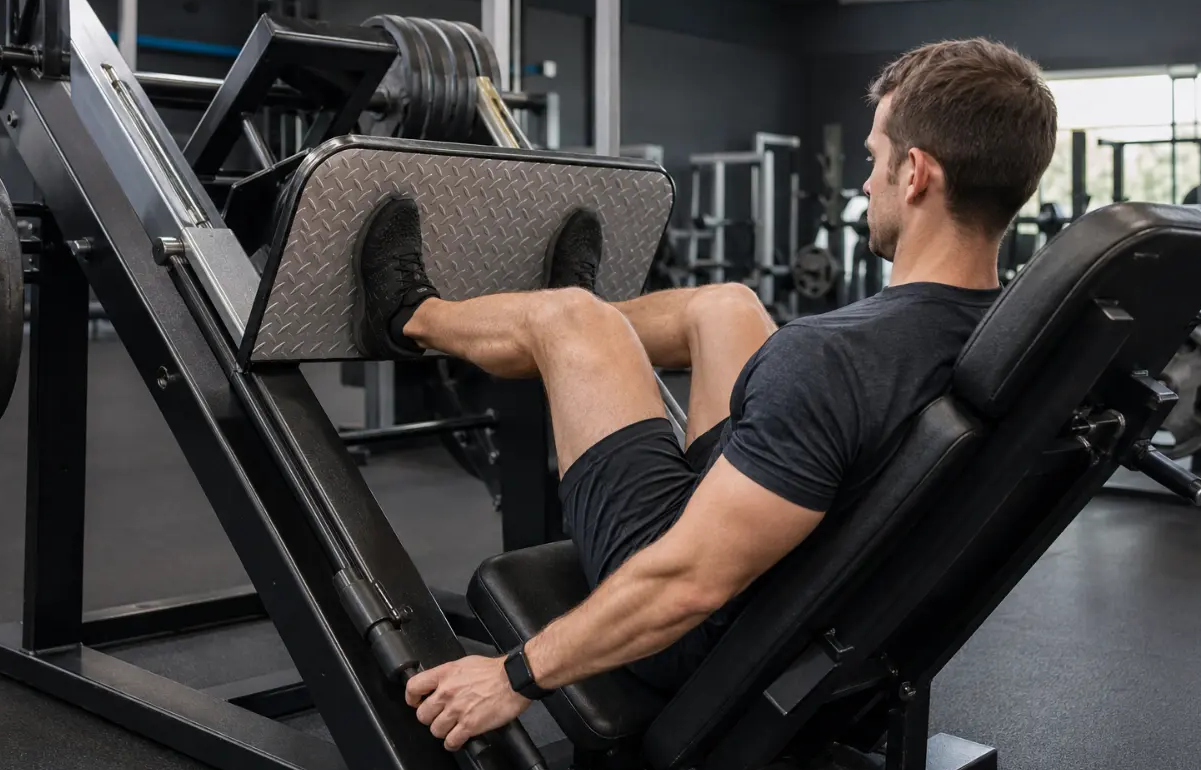
The leg press is a machine-based strength exercise that primarily targets the quadriceps, glutes, and other major lower-body muscles. Unlike free-weight squats, it supports the torso and guides the resistance along a fixed path, allowing the legs to work without balance becoming a major limiting factor.
The movement is relatively easy to learn, but effective training requires more than pushing a platform away from the body. Seat adjustment, foot placement, knee alignment, and depth all influence joint mechanics and muscular loading. Poor positioning can restrict the working range or place unnecessary stress on the knees, hips, and lower back.
Learning how to do leg press movements correctly helps establish consistent technique, select suitable resistance, and make the exercise a productive part of a strength-training program.
What Is the Leg Press Exercise?
The leg press exercise involves extending the knees and hips against resistance while the upper body rests against a padded support. Depending on the machine, either a weighted platform moves away from the lifter or the seat travels along a guided track.
Common in bodybuilding and general fitness programs, the exercise allows substantial resistance to be applied to the lower-body muscles without the trunk stabilization demands of a barbell squat. It is also used in some rehabilitation settings, where resistance and movement range can be adjusted to individual requirements.
Each repetition has two phases. During the lowering phase, the knees and hips bend as the resistance approaches the body. The quadriceps and hip extensors control this descent. During the pressing phase, these muscles produce force to extend the legs.
Although the machine controls the direction of travel, proper joint alignment remains the lifter’s responsibility.
Main Characteristics of the Leg Press
Several features explain the main leg press benefits:
- Guided movement: The machine establishes the general direction of resistance, reducing balance requirements.
- Adjustable loading: Most machines allow resistance to increase progressively through weight plates or a selectorized stack.
- Supported torso: The backrest reduces the need for active trunk stabilization compared with standing free-weight exercises.
- Single-leg training: Many models accommodate unilateral repetitions, allowing each leg to be trained separately.
- Training flexibility: Resistance, repetitions, and movement range can be adjusted for strength, hypertrophy, or muscular endurance.
These characteristics make the exercise useful for adding quadriceps training volume after other demanding lower-body movements.
What Muscles Does the Leg Press Work?
The leg press muscles worked include the quadriceps, gluteus maximus, and adductor magnus. The quadriceps produce knee extension, while the gluteus maximus and adductor magnus contribute to hip extension. Other muscles help stabilize the lower limbs.
How much work each muscle performs depends on joint angles, resistance, machine design, and individual anatomy.
Quadriceps
The quadriceps are the primary knee extensors and the main target of the leg press for quads.
This muscle group consists of four muscles:
- Rectus femoris
- Vastus lateralis
- Vastus medialis
- Vastus intermedius
The three vasti contribute directly to knee extension. The rectus femoris also crosses the hip joint, giving it a role in hip flexion and making its mechanical behavior different from that of the other quadriceps muscles.
During the lowering phase, the quadriceps resist knee flexion under load. As the legs extend, they generate force to move the platform or seat.
Greater knee flexion increases the working range of the quadriceps and may load them at longer muscle lengths. This can support hypertrophy when the movement remains controlled and the pelvis stays supported.
Gluteus Maximus
The gluteus maximus is a powerful hip extensor that contributes to the pressing phase as the hips move toward extension.
Its involvement becomes more substantial when the movement requires considerable hip flexion and extension. The load placed on the muscle depends on movement depth, machine geometry, and individual proportions.
For glute development, the leg press can complement squats, hip thrusts, and other hip-extension exercises. Placing the feet higher on the platform does not automatically produce greater glute activation because joint mechanics vary between machines and lifters.
Adductor Magnus
The adductor magnus occupies much of the inner thigh. Besides bringing the thigh toward the body’s midline, its posterior portion contributes to hip extension.
This makes it an important participant in compound lower-body movements, particularly when the hip extends from a flexed position.
A wider stance may change the demands placed on the adductor muscles, but it does not isolate the adductor magnus.
Hamstrings and Calves
The hamstrings cross both the hip and knee joints, which limits their role as primary movers during a conventional leg press.
As the hips extend, the hamstrings tend to shorten at the hip. Simultaneous knee extension tends to lengthen them at the knee. These opposing changes partially offset each other, limiting overall muscle-length variation. The hamstrings can still contribute to joint stabilization and force production, but they are less prominent than the quadriceps and major hip extensors.
The gastrocnemius and soleus help maintain ankle stability and control foot position against the platform. Their involvement is secondary, making dedicated calf exercises more appropriate for targeted calf development.
A separate calf press, performed through ankle movement while the knees remain relatively fixed, places more direct demands on the plantar flexors.
How to Do the Leg Press With Proper Form
Proper leg press form begins with the machine setup. The seat and backrest should allow comfortable knee and hip movement without forcing the pelvis away from its support.
Each repetition combines a controlled descent with a smooth press. The feet remain planted, and the resistance moves without bouncing or abrupt changes in direction.
Correct Foot Placement and Body Position
A stable starting position makes it easier to maintain alignment throughout the exercise.
- Sit with the back and pelvis supported against the pad.
- Position the feet approximately shoulder-width apart on the platform.
- Point the toes forward or slightly outward, according to natural hip and knee alignment.
- Adjust foot height so the heels remain supported and the ankles move comfortably.
- Set the seat to provide sufficient knee and hip flexion without excessive pelvic movement.
- Hold the machine’s handles, if available, to stabilize the torso.
The knees should generally travel in the same direction as the toes. Their exact path differs between lifters because hip structure, limb proportions, and preferred stance vary.
Keep the heel and forefoot in contact with the platform. Pressure may shift naturally, but avoid rolling onto either edge of the foot or allowing the heels to lift.
Before adding substantial resistance, check that the machine’s safety catches and range-of-motion stops are correctly positioned.
Range of Motion and Breathing Technique
A suitable leg press range of motion depends on hip mobility, machine design, and the ability to maintain pelvic stability.
Begin by bending the knees and hips gradually. Lower the resistance until reaching the deepest comfortable position that preserves control and contact with the backrest.
Depth varies between individuals. Long femurs, limited hip mobility, or differences in machine geometry can affect how far the knees approach the torso before the pelvis begins to rotate.
Avoid lowering so deeply that the lower back rounds away from the pad.
From the bottom position, press through the feet while extending the knees and hips together. Continue toward the knees’ natural end range without snapping into hyperextension.
For moderate-load sets, inhale during the descent and exhale gradually while pressing. Maintain enough trunk tension to prevent unwanted movement against the backrest.
Heavier sets may require brief, controlled bracing. Prolonged breath-holding is unnecessary for ordinary moderate-load training and may be inappropriate for people with certain cardiovascular conditions.
The pressing phase can be forceful without becoming abrupt. A controlled lowering phase helps preserve alignment and prevents momentum from taking over.
Different Types of Leg Press Machines
Leg press machines differ in orientation, resistance systems, and movement paths. These differences affect the resistance experienced throughout a repetition and the positions available to the lifter.
The most common leg press variations include inclined, horizontal, and vertical machines.
45-Degree Leg Press
The 45-degree leg press uses an inclined sled that travels along rails. The lifter sits beneath the platform and presses the carriage upward, usually against resistance supplied by weight plates.
Because the sled moves at an incline, the force needed to move it is not equivalent to lifting the same mass vertically. Effective resistance depends on the angle, carriage weight, friction, and other mechanical characteristics.
Consequently, the total weight loaded onto an inclined machine cannot be compared directly with the resistance displayed on a horizontal model.
This design commonly accommodates substantial loading and is frequently used for strength and hypertrophy training.
Horizontal Leg Press
A horizontal or seated leg press generally places the lifter in a more upright position, with the resistance moving along a nearly horizontal path.
Many models use a selectorized weight stack connected to a cable or lever mechanism. Others use weight plates.
The seat and platform arrangement can make the machine convenient to enter and adjust, although accessibility varies by model. Actual resistance depends on the internal mechanism rather than the displayed weight alone.
Horizontal machines accommodate a broad range of training experience when their adjustments suit the lifter’s proportions.
Vertical Leg Press
The vertical leg press places the resistance directly above the lifter, with the platform traveling along a predominantly vertical path.
This arrangement can require considerable hip and knee flexion. Available depth depends on machine dimensions, starting position, and individual mobility.
Pelvic control deserves particular attention because excessive hip flexion may cause the lower back to round away from its support.
Safety stops are especially important on vertical machines, where the loaded platform is positioned above the body.
No design is universally superior. The most suitable leg press machine provides comfortable joint positioning, manageable resistance, and reliable safety features.
Leg Press Foot Placement and Muscle Activation
Leg press foot placement changes the relationship between the hips, knees, and ankles. These adjustments influence mechanical demands, but they do not reliably isolate individual muscles.
The quadriceps, gluteus maximus, and adductor magnus remain involved across conventional stance variations. Foot position is best treated as a way to adjust joint mechanics and movement comfort.
High Foot Placement
Placing the feet higher on the platform changes the relationship between knee and hip movement.
Depending on machine geometry, this position may reduce knee flexion demands while altering the mechanical demands at the hip. Individual proportions and movement depth also influence the result.
A higher stance is sometimes used when performing the leg press for glutes. However, research does not consistently demonstrate a large or predictable increase in glute or hamstring activation from this adjustment alone.
The position should still permit stable pelvic contact and full heel support.
Low Foot Placement
Moving the feet lower can increase knee flexion and the demands associated with knee extension.
Under suitable conditions, this may place greater emphasis on the quadriceps. The effect varies between machines, and lower placement does not guarantee greater muscle growth.
This position also requires sufficient ankle dorsiflexion. If the heels rise or the ankles become uncomfortable, moving the feet slightly higher can improve the setup.
Wide Foot Placement
A wider stance changes hip positioning and may alter the contribution of the adductor muscles.
The effect depends on stance width, foot rotation, and hip anatomy. Excessive width can restrict comfortable movement or make knee alignment difficult to maintain.
Some lifters find a moderately wide stance more natural, particularly when a narrow position limits hip mobility.
Narrow Foot Placement
A narrow stance brings the feet closer together and changes the relationship between the knees and hips.
It is sometimes promoted as a way to target the outer quadriceps. However, stance width alone does not reliably isolate the vastus lateralis.
A narrower position may suit certain body proportions, but it should not restrict hip movement or interfere with knee tracking.
Common Leg Press Mistakes to Avoid
Most leg press mistakes occur when resistance, movement depth, or machine setup exceeds the lifter’s ability to maintain control.
Excessive Weight
Using more resistance than can be managed often produces shortened repetitions, uncontrolled lowering, or changes in posture to move the weight.
The weight displayed on the machine matters less than the ability to move it through a consistent range.
Increase resistance only after completing the intended repetitions without sacrificing depth or technique.
Lower-Back Rounding
As the knees approach the torso, the pelvis may rotate backward. Excessive movement can cause the lower back to lose contact with the pad.
This often indicates that the chosen depth or seat position exceeds the available hip flexion.
Adjusting the seat or slightly reducing the range of motion can help restore stability.
Knees Collapsing Inward
Substantial inward movement of the knees relative to the feet can indicate a loss of lower-limb control.
A perfectly fixed knee path is unnecessary, but pronounced changes in alignment under load should be addressed.
Reducing resistance and selecting a stance that accommodates natural hip movement may improve control.
Locking the Knees Aggressively
Snapping the knees into full extension can reduce muscular control and place unnecessary stress on the joints.
Controlled extension to a natural end position is different from forcefully driving the knees into hyperextension.
The final portion of each repetition should remain smooth.
Bouncing at the Bottom
Rapidly reversing direction at the deepest point can disturb body positioning and shift the movement toward momentum-driven pressing.
Maintain muscular tension and change direction without allowing the resistance to rebound.
Using an Inconsistent Range of Motion
Partial repetitions can be useful in specialized training, but unintentionally shortening the movement as fatigue increases makes progress harder to assess.
For conventional strength and hypertrophy training, consistent depth provides a clearer basis for comparing performance between sessions.
Leg Press vs Squats: Which Is Better?
The leg press vs squat comparison depends on the training goal.
Both exercises develop lower-body strength, but squats require greater coordination and stabilization while supporting resistance. The leg press reduces these demands through external support.
| Feature | Leg Press | Squat |
| Primary muscles | Quadriceps, glutes, adductor magnus | Quadriceps, glutes, adductor magnus |
| Balance requirements | Relatively low | Higher |
| Trunk stabilization | Reduced by back support | Substantial with free weights |
| Movement path | Guided by the machine | Controlled by the lifter |
| Technical demands | Generally lower | Generally higher |
| Loading comparison | Depends on machine mechanics | Depends on external load and squat variation |
| Exercise specificity | Machine-based lower-body pressing | Standing strength and coordination |
Advantages of the Leg Press
The supported position allows the lower-body muscles to be trained with less interference from balance and trunk fatigue.
This makes the exercise useful for adding quadriceps volume after squats or other compound movements. It can also accommodate challenging sets near muscular fatigue without the same coordination requirements as a free-weight squat.
Safety catches and controlled movement remain necessary during demanding sets.
Advantages of Squats
Squats develop lower-body strength while placing greater demands on coordination, balance, and trunk stabilization.
They are particularly valuable when the objective involves barbell performance or improving strength in standing movement patterns.
Free-weight squats also allow considerable variation through stance width, bar placement, and movement depth.
Choosing Between the Two
Both exercises can support quadriceps hypertrophy when training effort, volume, and progression are sufficient.
For maximal barbell squat strength, squat practice remains essential because strength gains are partly specific to the movement being trained.
When muscle development is the primary objective, the leg press can serve as a main lower-body exercise or supplement other movements. Including both is often practical, with squats providing a standing strength stimulus and the leg press supplying additional training volume.
FAQ
Is the Leg Press Good for Beginners?
Yes. The guided movement and supported torso can make the leg press easier to learn than many free-weight exercises.
Beginners should start with manageable resistance, learn the machine’s adjustments and safety mechanisms, and establish consistent technique before increasing the load.
How Much Weight Should Be Used on the Leg Press?
Appropriate loading depends on training experience, goals, and machine design.
Sets of approximately 6–15 repetitions offer a practical starting point for hypertrophy, although higher-repetition sets can also stimulate muscle growth when performed with sufficient effort.
A useful initial load allows the intended repetitions while leaving approximately two or three additional repetitions possible before technical failure.
Progression should preserve movement depth and control rather than simply increasing the displayed weight.
Does the Leg Press Build Glutes?
Yes. The gluteus maximus contributes to hip extension during the pressing phase.
Its training stimulus depends on resistance, hip movement, effort, and individual biomechanics. A sufficiently deep and stable range of motion can increase the demands placed on the hip extensors.
Hip thrusts, squats, and hip-hinge exercises provide different loading characteristics and can complement the leg press in a glute-focused program.
Can the Leg Press Replace Squats?
The leg press can substitute for squats when the main objective is lower-body muscle development rather than squat-specific strength or technique.
It does not reproduce the balance, trunk stabilization, and coordination demands of free-weight squatting.
Exercise selection should reflect the specific training goal rather than treating the two movements as mechanically equivalent.
How Often Should the Leg Press Be Performed?
The leg press can be included in a training program one to three times per week, depending on total lower-body volume, intensity, and recovery.
Two weekly sessions, for example, allow demanding quadriceps work to be distributed across separate workouts.
The appropriate frequency depends on the complete training program, including other exercises that load the same muscle groups.